Date
29-11-2026
Gilgit-Baltistan (GB) sits where the Karakoram, Himalayas and Hindu Kush meet. It borders China, Afghanistan's Wakhan Corridor and India's Ladakh. Before 1947 it fell under Dogra-ruled Jammu and Kashmir, partly as the Gilgit Wazarat and partly under Ladakh. Pakistan took control of it after 1947–48. The secret Karachi Agreement of 1949 then placed it under Islamabad's administration, and neither GB's people nor its leaders were consulted. The region is internally diverse. Dardistan (Gilgit) has Shina, Burushaski and Wakhi speakers and a sizeable Ismaili population. Baltistan is Balti-speaking and mostly Shia, with strong links to Ladakh. Diamer (Chilas) is largely Sunni, and sectarian violence has occurred there. GB has an elected assembly and chief minister. It is still not a province, and it has no seats in Pakistan's National Assembly or Senate. In July 2026 the GB Assembly unanimously asked for provisional provincial status and inclusion in the NFC Award. Local body elections, the first since 2004, are slated for December 2026 and April 2027. CPEC and the Khunjerab trade have improved connectivity. GB remains mainly a transit route, though, with little local manufacturing, few jobs and growing climate risks. The brief argues that the people's rights and aspirations matter as much as strategy. It also says India should engage its own Balti- and Shina-speaking communities.
Gilgit-Baltistan (GB) is mostly mentioned and recognised for its geopolitical significance. It is under illegal occupation of Pakistan and part of Pakistan Occupied Kashmir. It has been projected as a prominent tourist destination within and outside Pakistan. This region has more strategic significance than meets the eye. It is a mountainous region bordering Afghanistan's Wakhan Corridor through passes in Ghizer and upper Hunza (e.g. Chapursan/Irshad), while the Darkot route from Yasin leads mainly into Chitral (Khyber Pakhtunkhwa); it also borders China in the Hunza region and India in the Ladakh sector. Historically, Gilgit was a separate wazarat under the suzerainty of the Maharaj of Kashmir and it was leased to the British in 1935 as he Gilgit Agency, and Hunza and Nagar were tributary principalities. Baltistan (Skardu, Kargil tehsils) fell under the larger Ladakh Wazārat before 1947 during the Dogra rule. Also, the region’s complex political reality is shaped by questions of constitutional status, representation, identity and the its relationship with Pakistan.
However, in order to understand the region and the aspirations of its people , we need to look beyond tourism and geopolitics. This Issue Brief is an attempt to understand the region, and also to comprehend what place does GB occupy within Pakistan’s political and constitutional framework?
A Region at the Crossroads
GB lies at the convergence of three major mountain ranges: the Karakoram, the Himalayas and the Hindu Kush. It shares borders with China and Afghanistan and is connected to Pakistan’s broader road network through the Karakoram Highway (KKH) which passes through GB. Its strategic location has made the region significant for regional connectivity, trade, security and geopolitics from Pakistan’s perspective. GB also occupies an important position within the wider Kashmir issue, which continues to shape its constitutional status and political future.
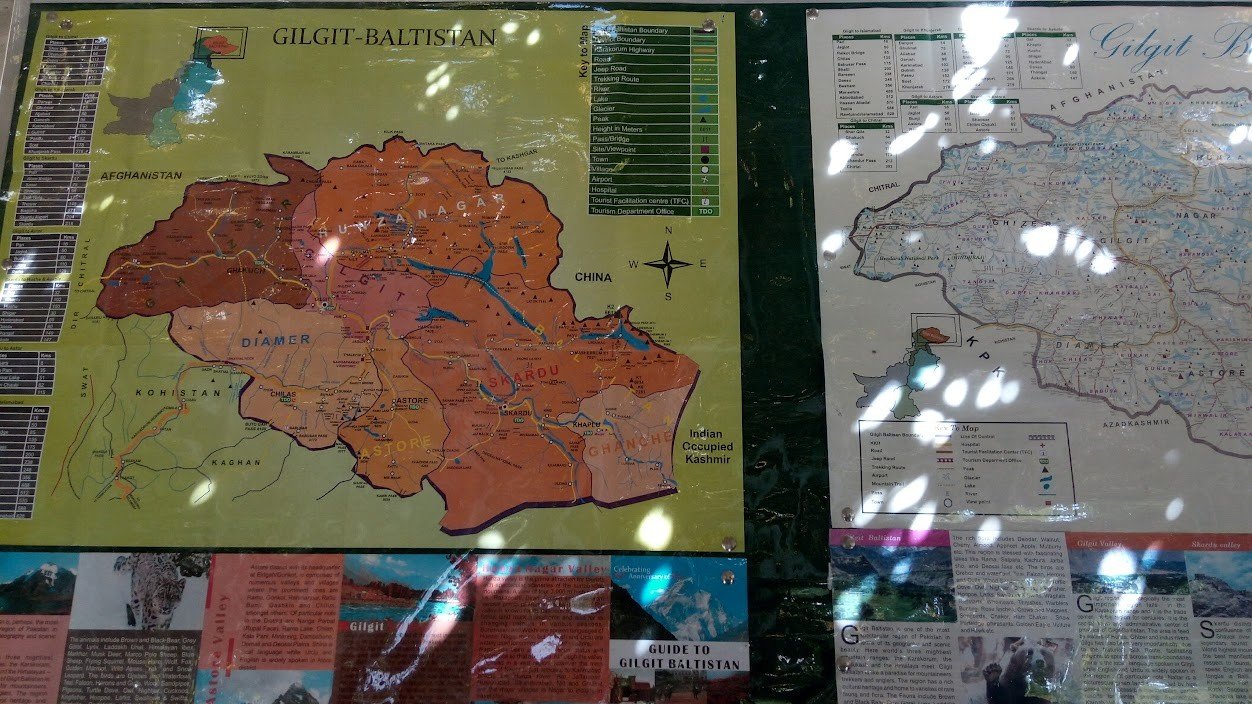
Image one: Map of Gilgit Baltistan as displayed inside Shigar Fort, Shigar.[1]
However, GB is more than a strategic corridor. Despite having a shared mountainous landscape and a common administrative framework, its constituent regions have distinct historical experiences, languages, religious compositions and cultural identities. Understanding these differences is essential to appreciating the region’s internal diversity.
Dardistan
Gilgit, an important administrative and political centre, is characterised by considerable linguistic and cultural diversity, with Shina, Wakhi and Burushaski among its prominent languages. Its districts and areas include Ghizer, Hunza, Nagar, Darel, Tangir and Gupis-Yasin. The religious composition varies across the region, with Ismaili communities particularly prominent in Hunza and parts of Ghizer, alongside substantial Shia and Sunni populations in other areas. The Ismailis of Gilgit belong to the Nizari Ismaili tradition within Shia Islam and recognise the Aga Khan as their spiritual Imam.
Gurez in Jammu and Kashmir shares deep historical, cultural and linguistic connections with Gilgit. Historically, both regions were part of a wider cultural landscape known as Dardistan, a mountainous region inhabited by diverse Dardic-speaking communities. Gurez and Gilgit were connected through traditional mountain routes, particularly the Burzil Pass, which facilitated trade, migration and social interaction. Both regions share a linguistic heritage, particularly the Shina language, spoken by Dard-Shin communities. It has to be noted that Gurez valley used to be the silk route for people of Kashmir who would travel from Bandipora through Gurez to Gilgit for trade and pilgrimage.
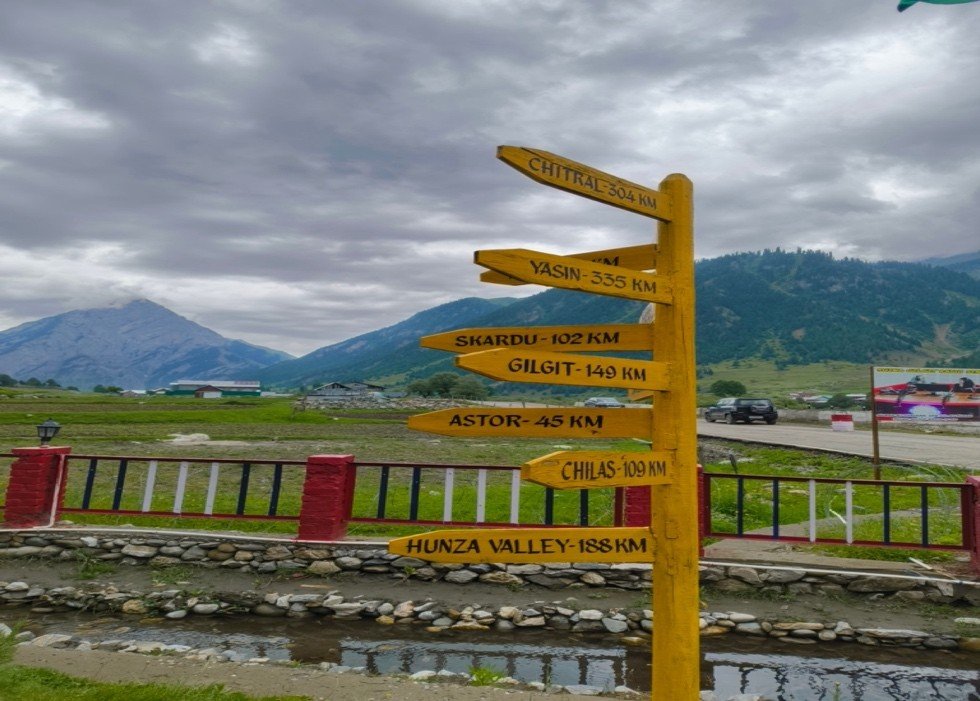
Image two: Shina Cultural Centre, Gurez
However, the Partition of 1947 and the subsequent division of Jammu and Kashmir disrupted these traditional connections. Today, Gurez and Gilgit remain important examples of the shared cultural and historical heritage of the wider Dardistan region and there is a need to focus on the shared heritage to understand the past connections and the larger concept of Dardistan. Additionally, there is a Gilgiti community who are settled in Kashmir in Hawal just below the Hari Parbat. There is a need to know more about them and bring them to the dialogue table and understand their stories and past.
Baltistan
Baltistan, with Skardu as its principal urban centre, comprises areas including Ghanche, Kharmang, Shigar and Rondu. Its predominantly Balti-speaking population has a distinctive linguistic and cultural heritage influenced by Tibetan traditions and historical connections with Ladakh. Religiously, Baltistan is predominantly Shia Muslim, particularly Twelver Shia, while the Nurbakhshi community has a significant presence, especially in Ghanche and the Khaplu area. Smaller Sunni communities also contribute to the region’s religious diversity. Ghanche district shares border with Turtuk village in Ladakh and the whole belt are followers of Sufi Nurbakhshi[2] sect of Islam. Kharmang district shares border with Kargil district in the Batalik sector. The famous Kargil Skardu road, which was part of the larger silk route crossed through this sector into Baltistan.
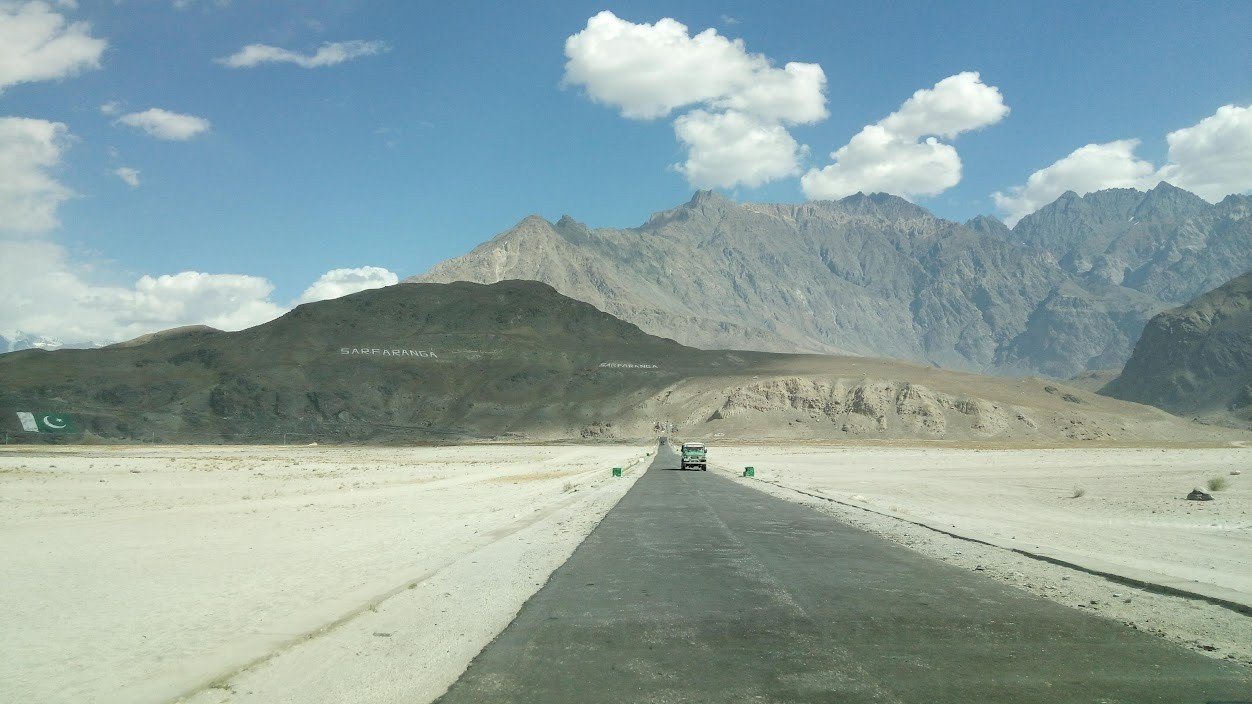
Image 3: Sarfaranga Desert, Shigar.
During my visit to Baltistan in 2017, I observed many similarities between the region and Ladakh. Skardu resembles Kargil in many ways and the Skardu Bazaar is just a photocopy of Balti Bazar in Kargil. The Sarfaranga desert in Shigar is more or less similar to the Hundur sand dunes in the Nubra valley, minus the two-humped camels. It is interesting to observe that many communities in Baltistan have migrated from the Indian side of Ladakh before 1948 and have since then settled there. In Sermik there is a community that migrated from the Zanskar Valley, and they still call themselves Zanskari. There is a small village in Kharmang district called Shilla (interestingly, there is a village called Shilla in Zanskar too). Most of the residents in the village migrated from the Suru Valley in Kargil. In many places, like in Skardu town there are rock carvings which offer clear evidence of its Buddhist past. These rock carvings, scattered across Baltistan, provide significant archaeological evidence of the region's Buddhist past. One of the most prominent examples is the Manthal Buddha Rock near Skardu, which features a large Buddha relief and reflects the region's Buddhist artistic heritage. Similarly, the Buddhist remains at Shigar, including stupas, monastery ruins, and ancient inscriptions, suggest that Baltistan was connected to wider Buddhist networks extending across Ladakh, Kashmir, Gilgit, and Central Asia. It is very important to acknowledge these connections, which will help us better understand the cultural roots of these communities.
Chilas
Diamer Division constitutes another distinct administrative unit within Gilgit-Baltistan, comprising Diamer and Astore districts. Its separate administrative jurisdiction and regional characteristics distinguish it from the Gilgit and Baltistan divisions. The population is predominantly Sunni Muslim, with many communities associated with the Deobandi school of thought. Shina is the principal local language, while Urdu is also widely used. The region’s cultural identity is shaped by strong community and tribal traditions, local customs, and a rich historical legacy, reflected in the ancient rock carvings and inscriptions found around Chilas and along the Indus Valley.
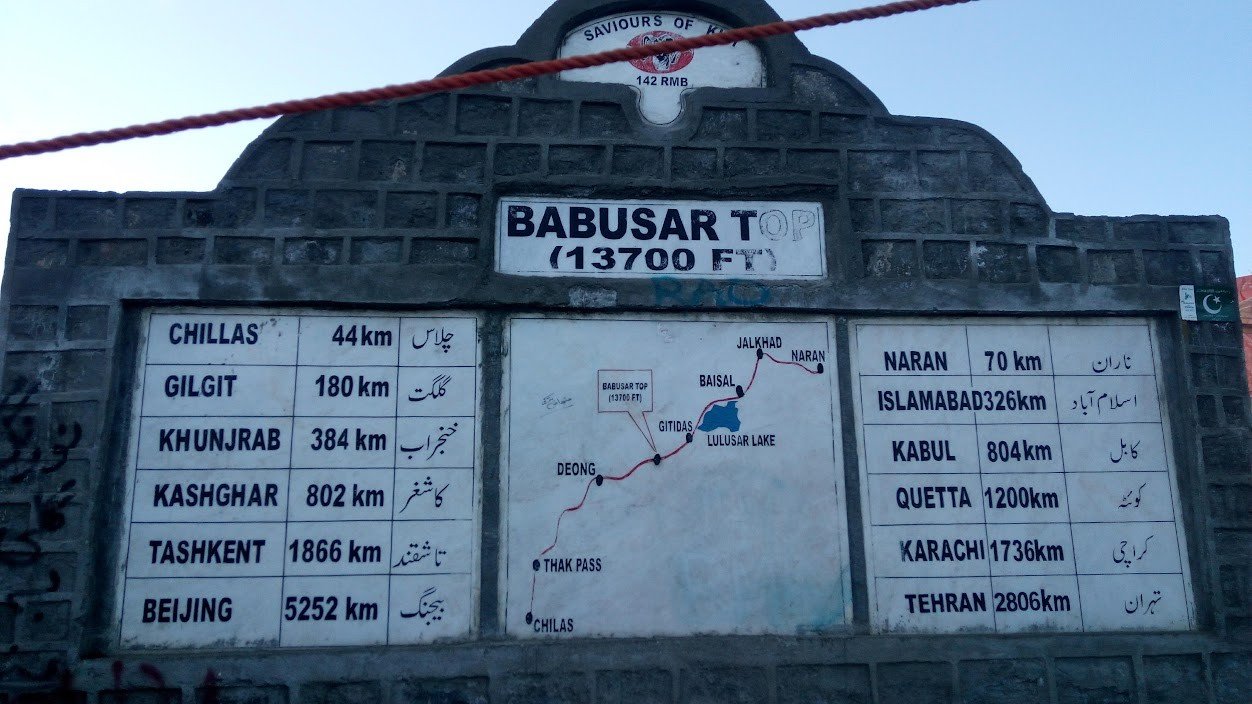
Image 4: Babusar Top connecting GB to Capital Islamabad.
The famous Babusar Top that connects GB to the Capital Islamabad passes though Chilas. It has to be noted that Chilas is infamous for the far-right Sunni Islamist groups who have, in the past, attacked buses going to Baltistan and have specifically targeted the Shias. Also, they have kidnapped many tourists in the past, and therefore nobody dares to cross the Babusar top at night as Chilas lies just at the foothills of the pass.
The Evolution of its Political Status
GB’s current political and constitutional status is closely linked to the events surrounding the Partition of British India in 1947 and the subsequent dispute over Jammu and Kashmir. Following the political developments of 1947–48, the region was notionally considered different from the so-called Azad Jammu and Kashmir (AJK) and treated as a stateless entity independent of the control of the Jammu and Kashmir state after it came under Pakistan’s illegal occupation and administration. In fact, the rulers of Pakistan forced the leader of AJK to virtually relinquish their claims on this Gilgit-Baltistan terrain. It was not, however, absorbed into the Pakistani state and given the same constitutional status as the country’s four provinces.
In fact, the Karachi Agreement of 28 April 1949 represents a particularly consequential exercise of Pakistan’s political and administrative manoeuvring in the territories of the erstwhile princely State of Jammu and Kashmir. Signed secretly in Karachi between Pakistan’s Minister without Portfolio Mushtaq Ahmed Gurmani, Sardar Muhammad Ibrahim Khan, President of the so-called Azad Jammu and Kashmir Government, and Chaudhry Ghulam Abbas, President of the All Jammu and Kashmir Muslim Conference, the agreement effectively enabled Pakistan to wrest direct administrative control over Gilgit-Baltistan, hitherto claimed as part of the larger Jammu and Kashmir State and within the political ambit of the AJK leadership.
Under its provisions, the entire administration of the Gilgit and Ladakh areas under the Political Agent at Gilgit was placed within Pakistan’s jurisdiction, while the AJK Government was confined to exercising limited administrative authority over the territories around Muzaffarabad. In effect, Pakistan used an arrangement negotiated with two Kashmiri political representatives to legitimise the administrative separation of an enormous strategically important territory without consulting either its local political leadership or its population. Neither Gilgit-Baltistan nor its representatives were party to the agreement, and the AJK leadership had no established administrative authority over the region that it could legitimately transfer.
The agreement thus accomplished two objectives: it marginalised the AJK Government and consolidated Islamabad’s direct control over Gilgit-Baltistan, while simultaneously creating a separate administrative and political entity out of territory that remained part of the larger unresolved Jammu and Kashmir dispute. The subsequent evolution of Gilgit-Baltistan as Pakistan’s separately administered Northern Areas, and eventually as a distinct administrative unit, institutionalised this division. The arrangement is particularly revealing of the asymmetry in Pakistan’s relationship with the territories it administers: while invoking the principle of self-determination internationally, it denied the people of Gilgit-Baltistan any meaningful participation in the very decision that determined their political and administrative future.
For several decades, it was known as the Northern Areas. Over time, successive Pakistani governments introduced administrative and political reforms to expand local representation and establish representative institutions. Today, Gilgit-Baltistan has its own elected assembly, chief minister, administrative machinery and judicial institutions. However, it is not recognised as a province under Pakistan’s Constitution and does not enjoy the same constitutional status as Punjab, Sindh, Khyber Pakhtunkhwa and Balochistan.
Instead, the region has been governed through a series of special administrative arrangements, most notably the Gilgit-Baltistan Empowerment and Self-Governance Order, 2009, followed by the Government of Gilgit-Baltistan Order, 2018. These measures were intended to strengthen local governance, expand political participation and provide greater administrative autonomy. Nevertheless, they did not grant Gilgit-Baltistan full provincial status. As a result, despite having elected representative institutions, the region continues to lack the constitutional standing and direct representation in Pakistan’s national legislature enjoyed by the four provinces. This arrangement has sustained longstanding debates over political rights, democratic representation and the region’s future constitutional position.
The unresolved issue of Jammu and Kashmir remains central to understanding Gilgit-Baltistan’s political status. Pakistan’s administrative arrangements for the region have evolved over time, but its constitutional future continues to be linked to the broader question of the disputed territory’s eventual settlement. This connection also explains why Gilgit-Baltistan’s governance has historically fallen within Pakistan’s wider institutional framework for Kashmir Affairs rather than being organised under the constitutional framework applicable to the provinces. Pakistan maintains that the Jammu and Kashmir dispute should be resolved in accordance with the wishes of its people and relevant international commitments. Consequently, GB faces the challenge of pursuing greater constitutional recognition, political representation and self-governance while its status remains intertwined with the wider Kashmir dispute. It has to be noted that if one has to travel to Baltistan from India, the Embassy of Pakistan in New Delhi does not give a direct Visa, instead it grants a city-specific visa for Islamabad. In Islamabad, one has to visit the Kashmir Affairs division and appeal the case on an individual basis. The permission paper to visit Baltistan is be stamped under the aegis of the Ministry of Kashmir Affairs.
The Politics of Provisional Provincial Status
For decades, the people of Gilgit-Baltistan have sought constitutional recognition, fundamental rights and equal political representation in Pakistan’s Senate and National Assembly. These demands reflect the region’s aspirations for greater political empowerment, constitutional protection and meaningful participation in national decision-making. Representation in the federal legislature would enable elected representatives from Gilgit-Baltistan to raise local concerns, contribute to the legislative process and participate more directly in decisions concerning national policies and resource distribution. Consequently, the region’s unresolved constitutional status remains one of the most significant issues shaping its political landscape.
On 16 July 2026, the Gilgit-Baltistan Assembly unanimously passed a resolution calling for provisional provincial status, constitutional and political rights, and representation in Pakistan’s National Assembly and Senate. The resolution was adopted under the Pakistan People’s Party (PPP)-led government headed by Chief Minister Amjad Hussain, who had taken the oath of office on 6 July 2026. The PPP emerged as the largest party in the June 2026 assembly elections, securing 12 of the 24 seats. It subsequently formed the government with the support of the Pakistan Muslim League–Nawaz (PML-N), although the latter later assumed the role of the opposition. The resolution also called for Gilgit-Baltistan’s inclusion in the National Finance Commission (NFC) Award until provisional provincial status is granted. Dawn reported on the assembly’s resolution on 17 July 2026.
Towards the end of September, a federal reform committee reportedly decided to broaden consultations on a proposed constitutional amendment that could provide Gilgit-Baltistan with provisional provincial status.
The significance of this resolution extends beyond party politics. Its unanimous adoption demonstrated a degree of consensus among assembly members on the need to address Gilgit-Baltistan’s constitutional position, despite political differences. Supporters of the demand argue that representation in federal institutions would give the region a stronger voice in national legislation, decisions on resource allocation and policies affecting its political and economic future. It would also provide a formal mechanism for elected representatives to communicate the region’s priorities directly to the federal government.
As discussed earlier, Gilgit-Baltistan is administered by Pakistan but does not enjoy the same constitutional status or parliamentary representation as the country’s four provinces. The demand for provisional provincial status seeks to address this gap by strengthening the region’s political representation and enabling its participation in national decision-making and resource allocation. The issue is also closely connected to development challenges. Chief Minister Amjad Hussain has highlighted funding shortfalls and persistent electricity shortages, despite Gilgit-Baltistan’s considerable hydropower potential. These concerns underline the relationship between constitutional recognition, access to federal resources and the region’s broader development needs.
It is important, however, to distinguish between the assembly’s demand and the federal government’s response. The resolution was passed by the GB Assembly; it was not a decision by Pakistan’s federal government to grant the region provisional provincial status. Instead, it called upon the federal government in Islamabad to undertake the necessary constitutional and legal changes to fulfil this demand. The proposal also raises a broader constitutional and diplomatic question: how can the people of GB secure meaningful democratic representation while the Jammu and Kashmir dispute remains unresolved? The assembly sought to address this concern by specifying that provisional provincial status should be granted without prejudice to Pakistan’s position on the Jammu and Kashmir dispute or the territory’s final disposition. This qualification reflects the attempt to reconcile GB’s aspirations for political rights and constitutional recognition with Pakistan’s stated position on the wider Kashmir dispute.
LG Elections: From Delays to Ballot Box
GB is preparing to conduct local body elections for the first time since 2004. According to reports in Pakistani media, the first phase of polling for municipal corporation seats in Gilgit, Skardu and Chilas is scheduled for 5 December 2026, while elections for district councils, union councils and municipal committees in other areas are expected to take place in April 2027. The revised election schedule follows several postponements because of harsh winter conditions and disagreements over amendments to the Local Government Act. The amended legislation streamlines the local government system into four categories, allows independent candidates to contest elections and reserves 17 per cent of seats for women.
The upcoming local government elections are significant because the absence of elected local bodies for more than two decades has restricted public participation in grassroots governance and limited residents’ ability to influence decisions concerning essential services such as roads, water supply, and sanitation. The restoration of elected councils could strengthen accountability, improve the delivery of public services and ensure that development initiatives better reflect the needs of local communities, particularly those in remote and underserved areas. The elections may also serve as an important test of GB’s democratic institutions and the government’s willingness to devolve administrative and financial authority beyond the regional administration. Given the region’s longstanding demands for greater political representation and constitutional clarity within Pakistan, the elections could help strengthen democratic participation and make governance more responsive to local priorities. However, their long-term impact will depend on whether elected representatives are granted meaningful decision-making powers, adequate financial resources and sufficient administrative autonomy to address the concerns of their constituencies.
People before Geopolitics
GB is frequently discussed in the context of its strategic importance, owing to its proximity to China and its position along the China-Pakistan Economic Corridor (CPEC). The Karakoram Highway and Khunjerab Pass play a crucial role in facilitating regional connectivity and cross-border trade, while tourism, hydropower, agriculture and mineral resources are widely regarded as key drivers of the region’s economic potential. However, GB’s strategic significance has not necessarily resulted in balanced economic development or greater political empowerment for its people. Challenges related to employment, land ownership and access to economic opportunities remain central to the concerns of local communities. In addition, the region’s rugged mountainous landscape and increasing vulnerability to climate-related risks, including glacial melting and floods, pose significant challenges to sustainable development.
CPEC-related infrastructure and trade with China through the Khunjerab Pass have improved connectivity and opened up new economic opportunities in Gilgit-Baltistan, but the benefits have not been equally shared across the region. The Khunjerab–Sost trade corridor has created opportunities for traders and businesses in Hunza and neighbouring areas to access Chinese markets and participate in cross-border commercial activities. However, the potential of this trade remains restricted by seasonal closures, high transportation costs, limited industrial capacity and a continued reliance on imported goods. A major concern is that GB continues to function largely as a transit route for CPEC, rather than emerging as a centre for local manufacturing, processing, and value addition. As a result, improved connectivity and increased trade have not necessarily generated adequate employment, higher household incomes or sustainable livelihood opportunities for local residents. To ensure that the region derives greater economic benefits from CPEC and cross-border trade, greater emphasis must be placed on strengthening local businesses, developing industries, expanding vocational and technical training, and creating employment opportunities that enable communities across GB to participate more directly in the region’s economic growth.
The Road Ahead
Any proposed constitutional arrangement must take into account the legal and diplomatic complexities surrounding the Jammu and Kashmir dispute. The debate over granting provisional provincial status to GB therefore extends beyond administrative restructuring; it raises fundamental questions about political representation, citizenship rights, governance and the relationship between the state and its citizens. Such a proposal would require a clear and workable constitutional and legal framework, political consensus at the federal level, and consideration of Pakistan’s stated position on the Kashmir dispute. Until the necessary constitutional changes are formally adopted and implemented, residents of GB will continue to lack the same representation in Pakistan’s federal Parliament as citizens of its four provinces.
Similarly, the proposed local body elections in GB must be assessed in light of their repeated postponements over more than two decades. Their significance will depend not only on whether polling takes place as scheduled, but also on whether the electoral process is transparent and elected representatives are provided with adequate authority, funding and administrative support to address local concerns. The conduct of elections alone cannot ensure effective decentralisation if decision-making powers remain concentrated within the regional and federal administrations. Ultimately, the key issue is whether the federal government will translate its commitments into concrete constitutional, legal and administrative measures. Addressing GB’s political and governance challenges requires sustained action rather than announcements made during political consultations, alongside a serious effort to reconcile the region’s strategic importance with the rights and democratic aspirations of its people.
GB holds considerable significance in the broader context of India–Pakistan relations. Its strategic location, close links with China and position within the disputed Jammu and Kashmir region make its future relevant to wider regional dynamics. However, viewing GB primarily through a strategic and security lens risks overlooking the concerns and aspirations of its people, who are directly affected by political decisions and security policies. One of the central challenges is to address the region’s uncertain constitutional status while responding to residents’ demands for democratic participation and political empowerment. Greater representation in national institutions, transparent governance, fair distribution of resources and meaningful public participation remain important considerations in discussions about GB’s future.
On the other hand, there is a need for India to engage with its Balti and Shina-speaking populations within the country. This has significant cultural, historical and strategic implications for its position on GB. Their linguistic and cultural connections across the LoC offer India an opportunity to understand the region beyond its territorial divisions. By preserving indigenous languages, documenting shared culture, India can strengthen its understanding of GB's diverse heritage and social realities. Such an approach would complement India's territorial position by recognising these communities as custodians of a shared Himalayan heritage whose identities, cultural rights and aspirations deserve independent recognition.
Conclusion
For India, Gilgit-Baltistan (GB) is more than a territorial claim repeatedly asserted in Parliament; it is also a society whose demands for political representation, constitutional rights and dignity are becoming increasingly vocal. Yet, New Delhi’s engagement with these aspirations has remained relatively muted. India must recognise that any Pakistani move to grant GB a form of ‘provisional provincial status’ would constitute an attempt to alter the administrative and political status quo in a territory that remains part of the larger Jammu and Kashmir dispute. Such moves must be consistently challenged through diplomatic and international channels. Equally important, however, is the need for India to move beyond declaratory positions and build credibility among the people of GB. This calls for a more sustained engagement with their aspirations, grievances and concerns, demonstrating that India’s position is not merely about territorial sovereignty but also about the political rights and democratic agency of the people who inhabit the region. Several concrete measures could help translate this approach into a credible policy such as.
Cultural outreach: Fund research, language documentation and archives for Balti, Shina and Burushaski in Ladakh, Kargil and Gurez. Support cultural centres such as the one in Gurez.
People-to-people links: Explore reviving heritage routes and facilitating divided-family contacts, such as the Kargil–Skardu road and the Burzil route. This would depend on security conditions and diplomatic progress.
Narrative and diplomatic strategy: Publicise the Karachi Agreement and the absence of GB's own consent. Raise GB's lack of representation, land and resource rights, and the CPEC-related concerns at international forums.
Institutional capacity: Set up a dedicated GB/PoK research and monitoring cell within the MEA or a think-tank network. It should track elections, constitutional changes, CPEC projects and climate risks such as glacial floods.
Domestic engagement: Bring in the Gilgiti community in Kashmir and the Balti and Shina speakers of Ladakh as stakeholders in policy. Their voices would give India's position more weight.
Done with care, this approach would turn India's claim into a long-term engagement that GB's people can see and trust.
Dr Zainab Akhter is a Research Fellow at the Centre for Peace Studies. She hails from Zanskar and had undertaken a visit to Gilgit and Baltistan in September 2017. She has her relatives who had migrated to Sermmik in 1948. The views expressed are her own.
[1] Note: All photos are taken by the author.
[2] For more on Noorbakshiya’s read: https://www.icpsnet.org/issuebrief/voices-borderland-identity-heritage-and-representation-balti-noorbakshias-turtuk