
South Asian Centre for Strategic Studies (SACSS)
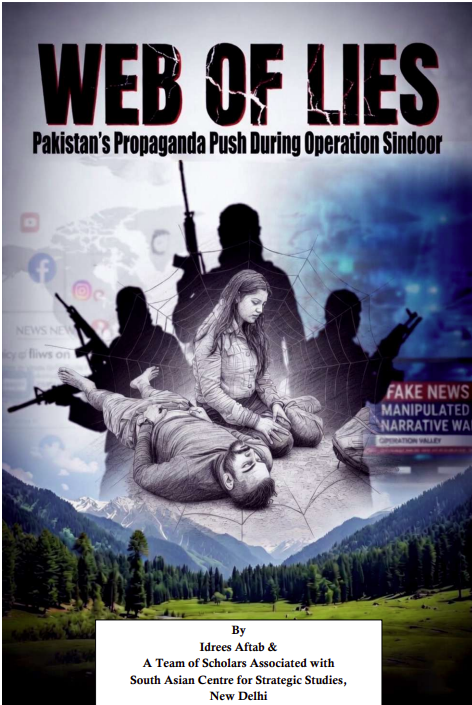 |
Web of Lies: Pakistan’s Propaganda Push During Operation SindoorIn the spring of 2025, the meadows of Pahalgam in Jammu and Kashmir bore witness to an atrocity that would reshape not only India-Pakistan relations but also the contours of modern hybrid warfare. On 22 April 2025, terrorists affiliated with The Resistance Front (TRF), a proxy of Pakistan-based Lashkar-e-Taiba (LeT), executed a meticulously planned religiously motivated massacre, killing 26 civilians—predominantly Hindu tourists. This attack, framed by the authors of Web of Lies as an act of ideological warfare rather than isolated terrorism, triggered India’s decisive military response: Operation Sindoor, launched on 7 May 2025. The book, authored by Idrees Aftab and a team of scholars at the South Asian Centre for Strategic Studies (SACSS) in New Delhi, offers a detailed examination of the subsequent information battle, revealing how Pakistan orchestrated a negative propaganda campaign against India to obscure its role, sow doubt, and contest the narrative on the global stage. Published in June 2026, this work stands as both a forensic analysis and a strategic warning about the weaponisation of perception in 21st-century conflict. ₹. 0.00 | Pages: 241 | Language: English Book | June 2026 | Download Complete [PDF] |
The South Asian Centre for Strategic Studies (SACSS) is a New Delhi–based research centre dedicated to the study of strategic, geopolitical, and security issues shaping South Asia and its extended neighbourhood. As a sisterly affiliate of the Centre for Peace Studies, SACSS seeks to contribute to informed public discourse, rigorous policy research, and regional understanding through multidisciplinary scholarship and strategic analysis.
SACSS was established with the objective of creating an independent intellectual platform that examines the rapidly evolving political and security environment of South Asia. The Centre focuses on both traditional and non-traditional security challenges, including interstate relations, military affairs, terrorism and extremism, great power competition, maritime security, border disputes, economic connectivity, climate-related security risks, and emerging technological challenges.
Located in New Delhi, SACSS brings together scholars, policy practitioners, strategic analysts, journalists, and young researchers to engage in evidence-based research and policy dialogue. The Centre aims to bridge the gap between academic inquiry and policymaking by producing research that is analytically robust, policy-relevant, and accessible to wider audiences.
Core Areas of Research
SACSS undertakes research and analysis across a broad range of themes, including:
-
South Asian geopolitics and regional security
-
India’s foreign and strategic policy
-
Military and defence studies
-
Terrorism, radicalisation, and counter-extremism
-
China’s role in South Asia and the Indian Ocean
-
Maritime and Indo-Pacific security
-
Nuclear strategy and deterrence
-
Border conflicts and regional instability
-
Peacebuilding and conflict resolution
-
Emerging technologies and strategic affairs
-
Climate change and human security
Vision
To emerge as a leading strategic studies platform in South Asia by promoting informed debate, credible scholarship, and policy-oriented research on regional and global security challenges.
Mission
-
To conduct high-quality research on strategic and geopolitical developments in South Asia.
-
To encourage informed dialogue on peace, security, and regional cooperation.
-
To provide a platform for scholars, policymakers, and practitioners to exchange ideas and perspectives.
-
To mentor and engage young researchers in the field of strategic and security studies.
-
To contribute constructively to public understanding of contemporary international affairs.
Activities
SACSS regularly engages in:
-
Research publications and policy briefs
-
Strategic commentaries and analytical essays
-
Conferences, seminars, and roundtable discussions
-
Track-II and academic dialogues
-
Capacity-building workshops and lectures
-
Collaborative research initiatives
Through its work, SACSS seeks to foster a deeper understanding of the strategic transformations unfolding across South Asia and beyond, while contributing to a more informed, peaceful, and stable regional order.