Journal of Peace Studies Style Sheet for Authors
The Journal of Peace Studies (JPS) is a peer-reviewed academic journal published by the Centre for Peace Studies (CPS), New Delhi. Dedicated to advancing scholarship in Peace and Conflict Studies, International Relations, Strategic Studies, Security Studies, Foreign Policy Analysis, Area Studies, and related interdisciplinary fields, the journal seeks to maintain the highest standards of academic rigor, originality, and scholarly integrity.
To ensure consistency, clarity, and professional presentation across all submissions, JPS follows a modified Harvard-Endnote referencing system widely used in International Relations and Strategic Studies scholarship. Authors are required to adhere to the citation, formatting, and stylistic conventions outlined in this Style Sheet. The guidelines provide detailed instructions on referencing books, journal articles, policy reports, government documents, treaties, online resources, and other scholarly materials, while also establishing standards for manuscript preparation, quotations, abbreviations, and subsequent citations.
Compliance with these guidelines will facilitate a smoother review and publication process and contribute to maintaining the scholarly quality and uniformity of the journal. Authors are encouraged to consult this Style Sheet carefully before submitting manuscripts for consideration.
Style Sheet for Authors
1. General Guidelines
The Journal of Peace Studies (JPS) follows a Modified Harvard-Endnote Style, commonly used in International Relations, Strategic Studies, Peace and Conflict Studies, International Law, and Security Studies.
Authors should:
- Use numbered endnotes rather than author-date citations.
- Number references consecutively throughout the manuscript.
- Provide complete bibliographic details at first citation.
- Use shortened references in subsequent citations.
- Use Ibid. for immediately preceding references.
- Use British English spelling.
- Italicise titles of books, journals, reports, treaties, and newspapers.
- Place article and chapter titles within double quotation marks.
2. In-Text Citation
References should appear as superscript numerals.
Example
Realist scholars have long argued that anarchy structures international politics.¹
Peacebuilding efforts increasingly incorporate local agency and ownership.²
3. Endnotes/References
References should appear at the end of the manuscript under the heading:
References:
4. Books
Format
Author Surname, Initial(s). (Year), Title of Book, page number(s), Publisher: Place of Publication.
Examples
- Morgenthau, H. J. (1948), Politics Among Nations: The Struggle for Power and Peace, p. 13, Alfred A. Knopf: New York.
- Waltz, K. N. (1979), Theory of International Politics, p. 88, Addison-Wesley: Reading.
- Bull, H. (1977), The Anarchical Society: A Study of Order in World Politics, p. 52, Macmillan: London.
- Buzan, B. and Wæver, O. (2003), Regions and Powers: The Structure of International Security, p. 25, Cambridge University Press: Cambridge.
5. Journal Articles
Format
Author Surname, Initial(s). (Year), “Article Title”, Journal Name, Volume (Issue), page number(s).
Examples
- Wendt, A. (1992), “Anarchy is What States Make of It: The Social Construction of Power Politics”, International Organization, 46(2), p. 391-425.
- Malla, M. W. (2022), “China’s Approach to the Iran‐Saudi Arabia Rivalry”, Middle East Policy, 29(1), p. 25-40.
6. Chapters in Edited Books
Format
Author Surname, Initial(s). (Year), “Chapter Title”, in Editor Initial(s). Surname (ed.), Book Title, page number(s), Publisher: Place.
Examples
- Walt, S. M. (2008), “International Relations: One World, Many Theories”, in C. Elman and M. F. Elman (eds.), The Realism Reader, p. 12-35, Routledge: London.
- Malla, M. W. (2020), “Madrasas and Extremism: South Asian Perspectives”, in R. Lukens-Bull and M. Woodward (eds.). Handbook of Contemporary Islam and Muslim Lives, p. 1169-1185, Springer: Cham
7. Edited Volumes
Format
Editor Surname, Initial(s). (ed.) (Year), Title, Publisher: Place.
Example
Booth, K. (ed.) (2005), Critical Security Studies and World Politics, Lynne Rienner: Boulder.
8. Policy Reports and Think Tank Publications
Format
Author Surname, Initial(s). (Year), Title, Report/Occasional Paper, Institution: Place.
Examples
- Cordesman, A. H. (2023), The Changing Military Balance in the Gulf, Strategic Report, CSIS: Washington, D.C.
- Malla, M. W. (2025), Structural Constraints and Strategic Inertia: Rethinking Gulf Security After Israel’s Doha Attack, Issue Brief, International Centre for Peace Studies: New Delhi.
9. Working Papers
Format
Author Surname, Initial(s). (Year), Title, Working Paper No., Institution.
Example
Nye, J. S. (2004), Soft Power and American Foreign Policy, Working Paper No. 7, Harvard University.
10. Newspaper Articles
Format
Author Surname, Initial(s). (Year), “Article Title”, Newspaper, Day Month.
Examples
- Ignatius, D. (2024), “The New Middle East Balance”, The Washington Post, 17 February.
- Raghavan, S. (2025), “India’s Strategic Calculus in West Asia”, The Hindu, 12 January.
11. Magazine Articles
Format
Author Surname, Initial(s). (Year), “Article Title”, Magazine, Day Month.
Example
Kaplan, R. D. (2024), “The Return of Geopolitics”, Foreign Affairs, March/April.
12. Online Sources
Format
Author/Organisation. (Year), “Title”, [Online], Available at: URL (Accessed Day Month Year).
Examples
- United Nations Development Programme (2024), “Human Development Report”, [Online], Available at: https://hdr.undp.org (Accessed 15 January 2026).
- Stockholm International Peace Research Institute (2025), “Military Expenditure Database”, [Online], Available at: https://www.sipri.org (Accessed 20 February 2026).
13. Government Documents
Format
Government Department/Agency. (Year), Title, Document Number, Place.
Example
Ministry of External Affairs, Government of India. (2024), Annual Report 2023–24, New Delhi.
14. United Nations Documents
Format
Organisation, Document Number, Date.
Examples
- United Nations General Assembly Resolution 2625 (XXV), 24 October 1970.
- United Nations Security Council Resolution 2728, 25 March 2024.
- United Nations Document A/78/123, 10 October 2024.
15. Treaties and International Agreements
Format
Treaty Name, Date, Official Citation.
Examples
- Charter of the United Nations, 26 June 1945, 1 UNTS XVI.
- Treaty on the Non-Proliferation of Nuclear Weapons, 1 July 1968, 729 UNTS 161.
- United Nations Convention on the Law of the Sea, 10 December 1982, 1833 UNTS 3.
16. Conference Papers
Format
Author Surname, Initial(s). (Year), “Title”, Paper presented at Conference Name, Location, Date.
Example
Acharya, A. (2023), “Multipolarity and Asian Regional Order”, Paper presented at the International Studies Association Annual Convention, Montréal, 15–18 March.
17. Doctoral Theses and Dissertations
Format
Author Surname, Initial(s). (Year), Title, PhD Thesis, University.
Example
Malla, M. W. (2023), Media-Foreign Policy Discourse: Al Jazeera English’s Coverage of Iran-Saudi Relations, PhD Thesis, Jawaharlal Nehru University.
18. Subsequent Citations
Immediate Repetition
Use:
Ibid.
or
Ibid., p. 145.
Example
- Waltz, Theory of International Politics, p. 88.
- Ibid., p. 91.
Later Repetition
Use shortened references.
Example
- Waltz, Theory of International Politics, p. 103.
- Acharya, “How Ideas Spread”, p. 248.
- Bull, The Anarchical Society, p. 75.
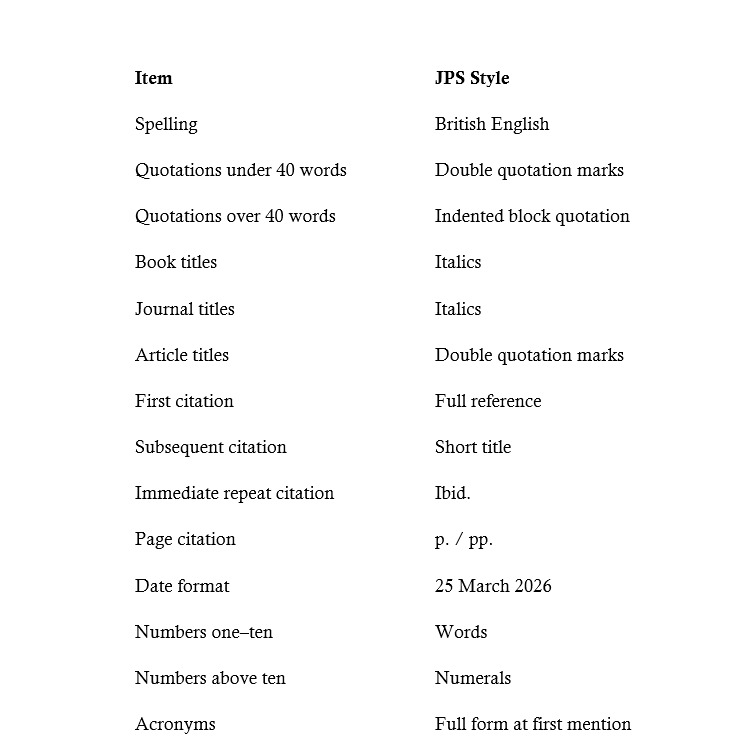
Style Conventions
Sample References Section
References
- Morgenthau, H. J. (1948), Politics Among Nations: The Struggle for Power and Peace, Alfred A. Knopf: New York.
- Malla, M. W. (2022), “China’s Approach to the Iran‐Saudi Arabia Rivalry”, Middle East Policy, 29(1), p. 25-40.
- Jervis, R. (1978), “Cooperation Under the Security Dilemma”, World Politics, 30(2), p. 167-214.
- Booth, K. (ed.) (2005), Critical Security Studies and World Politics, Lynne Rienner: Boulder.
- Kaplan, R. D. (2024), “The Return of Geopolitics”, Foreign Affairs, March/April.