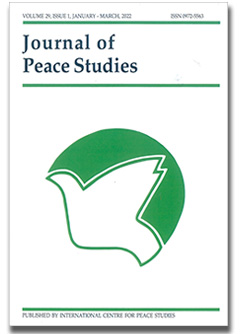
About The Journal
Journal of Peace Studies (ISSN: 0972-5563) is a quarterly peer-reviewed research journal published by the Centre for Peace Studies (CPS), New Delhi. Launched in 1993 by Prof. Riyaz Punjabi as a flagship publication of CPS, the journal has been published regularly for over three decades, making it one of the longest-running scholarly platforms in South Asia dedicated to peace and conflict studies.
With an interdisciplinary approach, the journal seeks to promote peace, dialogue, and mutual understanding among societies worldwide, with a particular emphasis on the South Asian region. It provides a forum for academics, researchers, students, journalists, policymakers, administrators, and diplomats to engage with critical issues of peace, security, democracy, and human rights. Journal of Peace Studies is widely recognised as a reference source of high scholarly value, especially for those engaged in research on peacebuilding, conflict resolution, and human rights.
Key Details
- Publisher: Centre for Peace Studies, New Delhi
- ISSN: 0972-5563
- Frequency: Quarterly
- Established: 1993
- Founding Editor: Late Professor Riyaz Punjabi
- Scope: Peace studies, conflict resolution, diplomacy, human rights, security studies, and interdisciplinary approaches to global and regional peace.
- Audience: Academics, researchers, students, journalists, policymakers, administrators, and diplomats.
Aims & Scope
Editorial Board
Chief Editor
Dr. Ashok Behuria
Chairman (Hony.), Centre for Peace Studies, New Delhi
Dr. Ashok Behuria is a distinguished scholar of South Asian politics and peacebuilding. His research spans inter-state relations, conflict resolution, and regional security. He has authored numerous publications on India’s foreign policy, Pakistan’s internal dynamics, and peace processes in South Asia.
Associate Editor
Dr. Mohmad Waseem Malla
Research Fellow, Centre for Peace Studies, New Delhi
Editorial Director, Middle East Outlook
Dr. Mohmad Waseem Malla specializes in West Asian and South Asian geopolitics, political communication, digital authoritarianism, and strategic rivalries. His work focuses on the intersection of technology, security, and diplomacy in contemporary global politics.
Advisory Board
- Saleem Kidwai
Professor (Retd.), Jawaharlal Nehru University, New Delhi - René Wadlow
President, Association of World Citizens, Novato, California - G. Balachandran
Co-Director, Albert Hirschman Centre on Democracy, Geneva Graduate Institute in Switzerland - Dr. Sandra Destradi
Chair of International Relations, University of Freiburg, Germany. - Dr Prafulla Kumar Prusty
Editorial Board Members
- Noor Ahmad Baba
Professor (Retd.), School of Politics and Governance, Central University of Kashmir, Ganderbal, Jammu and Kashmir, India. - Ajay Darshan Behera
Professor, MMAJ Academy of International Studies, Jamia Millia Islamia, New Delhi, India. - Smruti S. Pattanaik
Fellow, Manohar Parrikar Institute for Defence Studies and Analysis, New Delhi, India. - P. V. Ramana
Expert in insurgency, internal security, and conflict resolution, with published work on peacebuilding strategies in South Asia. - Rajesh Kharat
Centre for South Asian Studies, School of International Studies, Jawaharlal Nehru University, New Delhi, India.
Peer Review Policy
Journal of Peace Studies follows a rigorous double-blind peer review process to ensure the highest academic standards and integrity in its publications. All manuscripts submitted to the journal undergo a structured evaluation process before acceptance.
Review Process
- Initial Screening: Submitted manuscripts are first reviewed by the editorial office to ensure compliance with submission guidelines, scope, and ethical standards.
- Double-Blind Review: Eligible manuscripts are sent to at least two independent reviewers. Both the authors’ and reviewers’ identities are kept confidential to maintain impartiality.
- Evaluation Criteria: Reviewers assess manuscripts based on originality, methodological rigor, relevance to peace and conflict studies, clarity of presentation, and contribution to scholarship.
- Decision Outcomes: Reviewers may recommend acceptance, revision (major or minor), or rejection. Final decisions rest with the Chief Editor, in consultation with the Associate Editor and Editorial Board.
Timelines
- Average review period: 6–8 weeks.
- Authors are notified promptly of editorial decisions and provided with constructive feedback.
Ethical Standards
- The journal adheres to the Committee on Publication Ethics (COPE) guidelines.
- Reviewers are expected to disclose any conflicts of interest and maintain confidentiality.
- Manuscripts are screened for plagiarism using recognized tools before being sent for review.
Appeals and Complaints
- Authors may appeal editorial decisions by submitting a reasoned request to the Chief Editor.
- Complaints regarding the review process are handled transparently and in accordance with COPE best practices.
Publication Ethics
Journal of Peace Studies is committed to maintaining the highest standards of integrity, transparency, and accountability in scholarly publishing. The following ethical principles guide our editorial practices, peer review process, and author responsibilities.
1. Responsibilities of Authors
- Originality: Manuscripts must be original, unpublished, and not under consideration elsewhere.
- Plagiarism: All submissions are screened using plagiarism detection software (e.g., Turnitin/iThenticate). Plagiarised content will be rejected outright.
- AI Use Disclosure: Authors must disclose any use of AI-assisted tools (e.g., for language editing, data analysis, or drafting support) in the Acknowledgements section. AI tools cannot be listed as authors, and manuscripts generated primarily by AI without substantial human intellectual contribution will not be accepted.
- Authorship: Only individuals who have made significant contributions to the research and writing should be listed as authors.
- Data Integrity: Authors must ensure data accuracy and provide access to supporting evidence upon request.
- Conflicts of Interest: Any financial, institutional, or personal conflicts must be disclosed at the time of submission.
2. Responsibilities of Editors
- Fair Evaluation: Editors evaluate manuscripts solely on academic merit, relevance, and originality, without discrimination based on race, gender, religion, or political beliefs.
- Confidentiality: Editors must maintain confidentiality of submissions and reviewer identities.
- Decision Authority: The Chief Editor has final responsibility for acceptance or rejection, guided by reviewer recommendations and ethical standards.
- Conflict of Interest: Editors must recuse themselves from handling manuscripts where conflicts exist.
3. Responsibilities of Reviewers
- Objectivity: Reviews must be conducted impartially, with constructive feedback to improve the manuscript.
- Confidentiality: Manuscripts under review are confidential and must not be shared or discussed outside the review process.
- Conflict of Interest: Reviewers must disclose any conflicts and decline assignments where impartiality may be compromised.
- Timeliness: Reviewers are expected to complete evaluations within the agreed timeframe.
4. Publication Integrity
- Corrections: Errors identified post-publication will be corrected promptly through errata or corrigenda notices.
- Retractions: Articles may be retracted in cases of proven misconduct, plagiarism, or unreliable findings. Retraction notices will be clearly marked and linked to the original article.
- Withdrawal Policy: Authors may request withdrawal before peer review is complete; once accepted, withdrawal is permitted only under exceptional circumstances.
5. Ethical Oversight
- The journal adheres to COPE guidelines for handling ethical issues in publishing.
- Cases of misconduct (fabrication, falsification, plagiarism, duplicate submission) will be investigated thoroughly, and appropriate action will be taken.
- The journal encourages transparency and accountability in research, promoting peace and human rights scholarship with integrity.
Open Access & Licensing Policy
Journal of Peace Studies is committed to the widest possible dissemination of scholarly work in the fields of peace, conflict resolution, and human rights. To achieve this, the journal follows a transparent access and licensing policy.
1. Access Policy
- The journal is published quarterly and is made available both in print and online.
- Online content is accessible to readers worldwide through the official website of the Centre for Peace Studies (CPS).
- The journal supports open access principles, ensuring that research is freely available to academics, practitioners, policymakers, and the general public without subscription barriers.
2. Licensing and Copyright
- Authors retain the copyright of their work while granting the journal the right to publish and disseminate it.
- Articles are published under a Creative Commons Attribution (CC BY) license, unless otherwise specified. This permits unrestricted use, distribution, and reproduction in any medium, provided the original work is properly cited.
- Authors are responsible for securing permission to reproduce any copyrighted material (figures, tables, or excerpts) included in their manuscript.
3. Author Rights
- Authors may archive the final published version of their article in institutional repositories, personal websites, or academic networks, provided proper citation and a link to the journal’s website are included.
- Authors are free to use their published work for teaching, presentations, and further research.
4. Reader Rights
- Readers may download, share, and cite articles without restriction, provided attribution is given to the original source.
- Commercial use of published material requires prior permission from the publisher.
5. Compliance with International Standards
- The journal’s open access and licensing practices are aligned with COPE, DOAJ, and Scopus requirements.
- By adopting Creative Commons licensing, the journal ensures transparency, accessibility, and ethical dissemination of knowledge.
6. Privacy Policy
- Journal of Peace Studies respects the privacy of authors, reviewers, and readers. Personal information collected during manuscript submission, peer review, or subscription is used solely for editorial and communication purposes. The journal does not share personal data with third parties, except as required by law or indexing services. All data is stored securely in compliance with international privacy standards.
Indexing & Abstracting
Journal of Peace Studies is committed to ensuring maximum visibility and accessibility of its published research. Indexing and abstracting in reputable databases enhances the journal’s reach among scholars, practitioners, and policymakers worldwide.
1. Current Indexing
- The journal is currently catalogued and circulated through the Centre for Peace Studies (CPS) network. The DOI is procured from Zenodo Online Repository.
- It is available online via the official CPS website, ensuring global access to current and past issues.
- Selected articles are referenced in academic libraries, research institutions, and peace studies networks.
2. Abstracting Services
- Each article published in the journal includes a structured abstract, keywords, and author details to facilitate discoverability.
- Metadata is formatted to be compatible with international abstracting services and institutional repositories.
3. Future Indexing Goals
- Inclusion in Scopus, one of the world’s leading abstract and citation databases.
- Inclusion in Directory of Open Access Journals (DOAJ) to strengthen open access visibility.
- Registration with CrossRef to assign DOIs (Digital Object Identifiers) for all published articles.
- Expansion into other international databases such as EBSCO, ProQuest, and JSTOR to broaden readership.
4. Citation Visibility
- Authors are encouraged to share their published work in institutional repositories, academic networks, and conferences to enhance citation impact.
- The journal actively promotes published articles through CPS platforms, newsletters, and academic collaborations.
Current Issue

Archives
Journal of Peace Studies has been published regularly since 1993, providing a rich archive of scholarship on peace, conflict resolution, diplomacy, and human rights. The archives serve as a valuable resource for researchers, policymakers, and practitioners seeking historical and contemporary perspectives on peace studies.
Previous Issues
Submission Guidelines
General Guidelines for Submission
Researchers, scholars, and practitioners submitting manuscripts to the Journal of Peace Studies are requested to adhere to the following guidelines to ensure uniformity, quality, and timely processing of their submissions.
- Formatting of Manuscripts
- Manuscripts must be typed in double-spacing, using Times New Roman, 12-point font.
- Submit manuscripts in Microsoft Word format (.doc or .docx).
- Maintain standard margins (1 inch / 2.54 cm) on all sides.
- Headings and subheadings should be clearly marked and consistently styled.
- Word Limit
- Research articles: 3,500–5,000 words (including footnotes and references).
- Shorter research notes, commentaries, or review essays may be considered at the discretion of the editorial team.
- Abstract and Author Information
- Each submission must include an abstract of 150–200 words, outlining the research question, methodology, key findings, and relevance.
- Provide a biographical note (100–150 words) with name, institutional affiliation, research interests, and email address.
- Plagiarism and Originality
- Manuscripts must be original and unpublished.
- Simultaneous submissions to other journals are not permitted.
- All submissions are screened for plagiarism using recognized software (e.g., Turnitin/iThenticate).
- Use of Artificial Intelligence (AI) Tools
- Authors must disclose any use of AI-assisted tools (e.g., for language editing, data analysis, or drafting support) in the Acknowledgements section.
- AI tools cannot be listed as authors. Responsibility for the content rests solely with the human authors.
- Submissions generated primarily by AI without substantial human intellectual contribution will not be accepted.
- The journal reserves the right to screen manuscripts for AI-generated originality to ensure compliance with ethical and scholarly standards.
- Referencing Style: Harvard Style
Journal of Peace Studies follows a Modified Harvard-Endnote Style, commonly used in International Relations, Strategic Studies, Peace and Conflict Studies, International Law, and Security Studies.
Authors should:
- Use numbered endnotes rather than author-date citations.
- Number references consecutively throughout the manuscript.
- Provide complete bibliographic details at first citation.
- Use shortened references in subsequent citations.
- Use Ibid. for immediately preceding references.
- Use British English spelling.
- Italicise titles of books, journals, reports, treaties, and newspapers.
- Place article and chapter titles within double quotation marks.
In-Text Citation
References should appear as superscript numerals.
Example
Realist scholars have long argued that anarchy structures international politics.¹
Peacebuilding efforts increasingly incorporate local agency and ownership.²
Endnotes/References
References should appear at the end of the manuscript under the heading.
Footnotes
- Use sparingly, only for clarification or additional information.
Do not use footnotes for bibliographic references.
To access the style sheet: Click Here (Link to PDF STYLESHEET)
References:
a) Books
Author Surname, Initial(s). (Year), TitleofBook, page number(s), Publisher: Place of Publication.
Examples
Waltz, K. N. (1979), TheoryofInternationalPolitics, p. 88, Addison-Wesley: Reading.
b) Journal Articles
Author Surname, Initial(s). (Year), “Article Title”, JournalName, Volume (Issue), page number(s), DOI
Examples
Malla, M. W. (2022), “China’s Approach to the Iran-Saudi Arabia Rivalry”, Middle East Policy, 29(1), p. 25-40, DOI: https://doi.org/10.1111/mepo.12613
- Chapter in an Edited Book
AuthorSurname, Initial(s). (Year), “Chapter Title”, in Editor Initial(s). Surname (ed.), Book Title, page number(s), Publisher: Place.
Examples
Malla, M. W. (2020), “Madrasas and Extremism: South Asian Perspectives”, in R. Lukens-Bull and M. Woodward (eds.). Handbook of Contemporary Islam and Muslim Lives, p. 1169-1185, Springer: Cham
d) Edited Volumes
Editor Surname, Initial(s). (ed.) (Year), Title, Publisher: Place.
Example
Booth, K. (ed.) (2005), CriticalSecurityStudiesandWorldPolitics, Lynne Rienner: Boulder.
- Policy Reports and Think Tank Publications
Author Surname, Initial(s). (Year), Title, Report/Occasional Paper, Institution, Date, Available at: www.abcd.com (Accessed DDMMYYYY).
Examples:
Malla, M. W. (2025), StructuralConstraintsandStrategicInertia:Rethinking Gulf Security After Israel’s Doha Attack, Issue Brief, Centre for Peace Studies, 24 October, Available at: https://www.icpsnet.org/issuebrief/Structural-Constraints-and-Strategic-Inertia (Accessed 10 January 2026)
f) Working Papers
Author Surname, Initial(s). (Year), Title, Working Paper No., Institution.
Example:
Nye, J. S. (2004), SoftPowerandAmericanForeignPolicy, Working Paper No. 7, Harvard University.
- Newspaper Articles
Author Surname, Initial(s). (Year), “Article Title”, Newspaper, Day Month, Available at: www.abcd.com (Accessed DDMMYYYY)
Examples
Johny, S. (2026), “Iran’s President seeks ‘fair, equitable negotiations’ with U.S.”, The Hindu, 3 February, Available at: https://www.thehindu.com/news/international/irans-president-seeks-fair-equitable-negotiations-with-united-states/article70586258.ece (Accessed 5 March 2026)
h) Magazine Articles
Author Surname, Initial(s). (Year), “Article Title”, Magazine, Day Month/Issue, Available at: www.abcd.com (Accessed DDMMYYYY)
Example
Mead, W. R. (2024), “The Return of Geopolitics”, ForeignAffairs, May/June 2014, Available at: https://www.foreignaffairs.com/articles/china/2014-04-17/return-geopolitics (Accessed 10 March 2026)
i) Online Sources
Author/Organisation. (Year), “Title”, [Online], Available at: URL (Accessed Day Month Year).
Examples
United Nations Development Programme (2024), “Human Development Report”, [Online], Available at: https://hdr.undp.org (Accessed 15 January 2026).
- Government Documents
Government Department/Agency. (Year), Title, Document Number, Place.
Example
Ministry of External Affairs, Government of India. (2024), AnnualReport2023–24, New Delhi.
- United Nations Documents Format
Organisation, Document Number, Date.
Examples
United Nations General Assembly Resolution 2625 (XXV), 24 October 1970.
- Treaties and International Agreements
Treaty Name, Date, Official Citation.
Examples
- Charter of the United Nations, 26 June 1945, 1 UNTS
- Treaty on the Non-Proliferation of Nuclear Weapons, 1 July 1968, 729 UNTS
- Conference Papers
Author Surname, Initial(s). (Year), “Title”, Paper presented at Conference Name, Location, Date.
Example
Acharya, A. (2023), “Multipolarity and Asian Regional Order”, Paper presented at the International Studies Association Annual Convention, Montréal, 15–18 March.
- Doctoral Theses and Dissertations
Author Surname, Initial(s). (Year), Title, PhD Thesis, University.
Example
Malla, M. W. (2023), Media-Foreign Policy Discourse: Al Jazeera English’s Coverage of Iran-Saudi Relations, PhD Thesis, Jawaharlal Nehru University.
-
Subsequent Citations
Immediate Repetition
Use:
Ibid.
or
Ibid., p. 145.
Example
Waltz, TheoryofInternationalPolitics, p. 88.
Ibid., p. 91.
Later Repetition
Use shortened references.
Example
Waltz, TheoryofInternationalPolitics, p. 103.
-
Reference Section Sample:
- Morgenthau, J. (1948), PoliticsAmongNations:TheStruggleforPowerandPeace, Alfred A. Knopf: New York.
- Malla, W. (2022), “China’s Approach to the Iran-Saudi Arabia Rivalry”,
MiddleEastPolicy, 29(1), p. 25-40.
- Jervis, (1978), “Cooperation Under the Security Dilemma”, WorldPolitics, 30(2), p. 167-214.
- Booth, (ed.) (2005), CriticalSecurityStudiesandWorldPolitics, Lynne Rienner: Boulder.
- Kaplan, D. (2024), “The Return of Geopolitics”, ForeignAffairs, March/April.
-
Note on consistency:
- Use a reference management tool (Zotero, Mendeley, EndNote) with Harvard style settings.
- Cross-check all citations for completeness and accuracy.
- Avoid over-reliance on a single source unless central to the argument.
Get Submission
To buy a subscription to the Journal of Peace Studies (Print), contact: jps@icpsnet.org or cpsndjps@gmail.com
Rates Applicable Currently:
- Single copy: INR 350
- Annual subscription (India)
Individual: INR 1400
Institutional: INR 2000
- Annual subscription (Overseas)
Individual: USD 15 / GBP 11
Institutional: USD 60 / GBP 44
Contact
Journal of Peace Studies is published by the Centre for Peace Studies (CPS), New Delhi. Authors, reviewers, and readers are encouraged to contact the editorial office for submissions, queries, and general information.
Editorial Office
Centre for Peace Studies (CPS)
New Delhi, India
Chief Editor: Dr. Ashok Behuria
Associate Editor: Dr. Mohmad Waseem Malla
Submission & Queries
- Email (Submissions & Editorial Queries): jps@icpsnet.org, cpsndjps@gmail.com
- General Inquiries: cpsndjps@gmail.com
- Website: https://icpsnet.org/journal-of-peace-studies
Postal Address
Centre for Peace Studies (CPS)
157/9, Block 4, Second Floor, Kishangarh (opposite Apex / Ambience Tower), Vasant Kunj, New Delhi, India, 110070